Animate unfolding paper with AI
Reveal a sketch or short message as a crumpled note opens. Get individual transparent frames you can time, reposition and reuse against your own background.
To animate unfolding paper with AI, imagine the final frame first. A scrap that opens to reveal a mountain drawing needs a different last pose from a shopping list that lands on a kitchen table. With paper-unfold-frames, you describe that destination and ask an image model to draw nine stages on one sheet, keeping the light and surface reasonably consistent.
A local script turns the blue-backed grid into nine separate transparent images. Place them at the same centre point on a canvas, pause on the closed ball, then let the corners unfold one image at a time. If the drawing should follow the creases, include it in the original prompt. Lettering drawn over the finished frames will sit above the folds.
What it does
- Reveal a short title at the end of a sequence without needing a physical prop or camera.
- Try plain, lined or torn notebook paper while keeping the same message and playback rhythm.
- Open a lesson or close a film with an original hand-drawn reveal.
- Change the desk or background colour after the frame edges have been cut out.
- Delay the last frame until the lettering lands on the right beat in a voiceover.
Install and use
- Connect an authorised GPT image endpoint or Figma image-generation tool. Allow for separate model fees or Figma AI credits. Install Python with Pillow, NumPy and SciPy for extraction and have a canvas composition ready for playback.
- Describe the paper and its final design. Request one nine-cell grid and inspect the lettering and fold order before cutting it up.
- Save the result locally, extract the transparent frames and play them in order. Adjust the holds and add a licensed rustle if desired.
FAQ
Source
Made by Kristofer Jussmann (OpenRootdev). Original skill: paper-unfold-frames, published on GitHub under the MIT licence.
View on GitHubRelated products
- SkillNew
Animate SVG scenes with AI
Create editable scene JSON containing vector artwork and keyframe tracks, choose a visual style and inspect the action through a local preview player.
Free - SkillNew
Create animated GIFs with AI
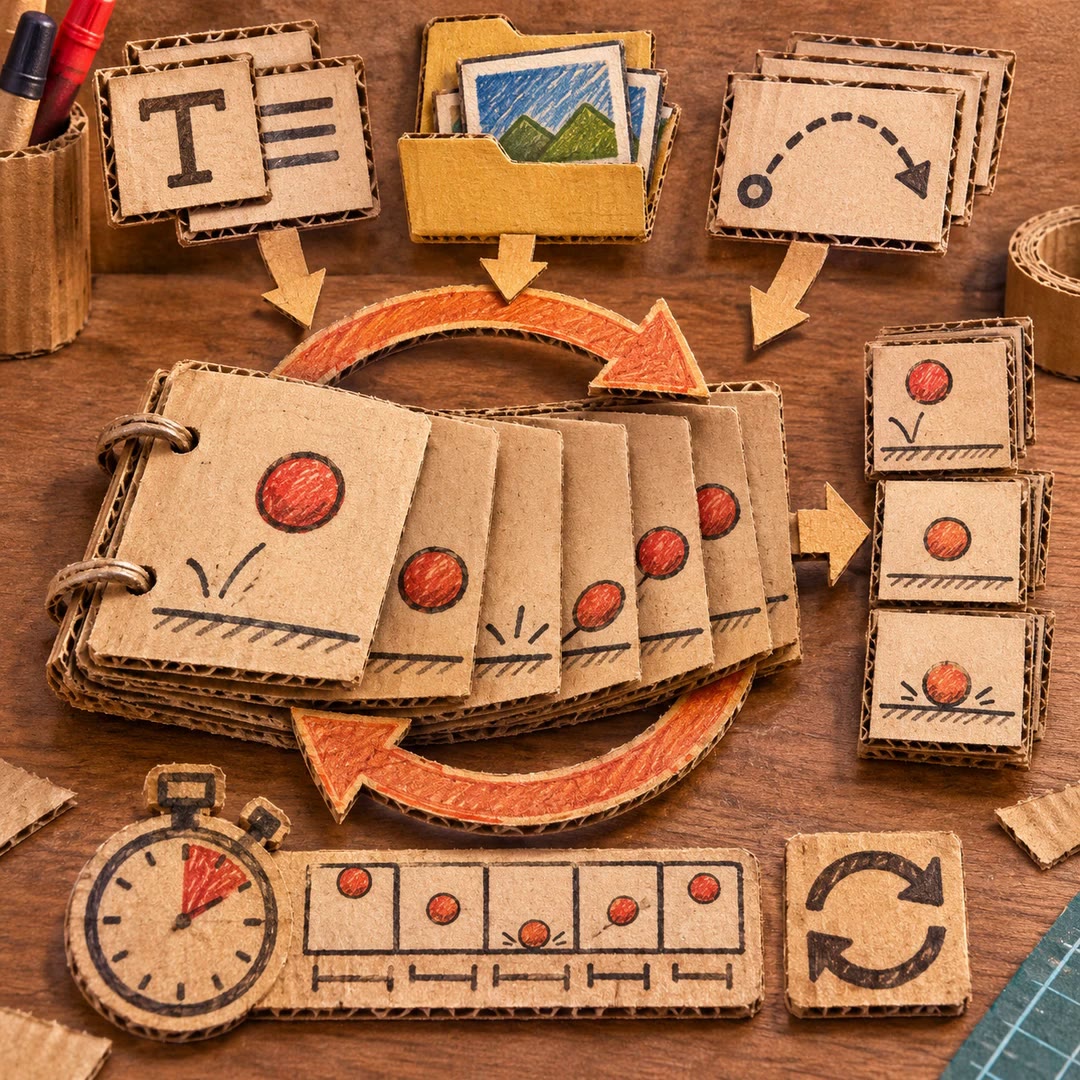
Turn text frames, image folders or vector motion into GIF/APNG, control timing and looping, and extract an existing animation into frames with their original delays.
Free - SkillNew
Create cartoon shorts with AI
Plan an invented vertical cartoon, author vector scenes, synchronise speech and captions, then review the render and prepare video files without automatic publishing.
Free